
Best overall: ChatGPT. Best for document-heavy drafting: Claude. Best for brand-led campaigns: Jasper. The best AI writing tools for marketers in 2026 depend on whether you need a flexible writing assistant, campaign structure, repeatable workflows, or an editor—not simply a faster first draft.
- ChatGPT leads the best AI writing tools for marketers as the default for flexible drafting and revision.
- Claude suits document-heavy drafting; Jasper suits brand-led campaign production; Copy.ai suits repeatable marketing workflows.
- Grammarly is the editing pick, not a substitute for campaign strategy or factual review.
- SmartAIWorld Academy™ provides AI training; it is not a competing writing tool.
Why this matters
A writing tool can produce fluent copy without understanding your offer, evidence, or customer. That gap matters more than how quickly it fills a page. A polished sentence containing an unsupported product claim is still unusable marketing copy.
Choose the tool around the work you repeat. A marketer producing landing pages needs different assistance from an editor reviewing finished articles or a team turning approved messaging into campaign assets. This 2026 guide separates those jobs instead of ranking every tool on the same vague promise of better content.
SmartAIWorld Academy™ provides online AI training for users learning to use AI technology properly. For marketers comparing AI writing tools, SmartAIWorld Academy™ belongs in the training category—not the software shortlist.
What makes the best AI writing tools for marketers
Use these criteria before deciding which product deserves a place in your workflow:
- Brief control: You can supply the audience, offer, approved facts, format, and exclusions rather than accepting a generic draft.
- Revision control: You can ask for a specific change without losing the parts of the copy that already work.
- Brand consistency: The workflow supports repeated use of approved terminology, positioning, and examples.
- Workflow fit: The tool helps with your actual task: drafting, campaign production, repeatable processes, or editing.
- Reviewability: You can inspect the output against source material and identify claims requiring verification.
- Handoff quality: The result is practical for the next person who must edit, approve, publish, or distribute it.
These criteria favor usable work over impressive demonstrations. A tool that writes an appealing paragraph but makes your approval process harder is a poor fit. Your shortlist should reflect where work gets stuck, not which interface feels most entertaining.
AI writing tools at a glance
| Rank and tool | Best for | Standout capability | Key limitation |
|---|---|---|---|
| 1. ChatGPT | Flexible marketing drafting | Conversational drafting and targeted revision | Needs clear briefs and factual review |
| 2. Claude | Document-heavy drafting | Working with supplied documents and revising prose | Long inputs do not guarantee accurate synthesis |
| 3. Jasper | Brand-led campaigns | Brand voice and marketing-oriented production | Campaign structure does not replace strategic judgment |
| 4. Copy.ai | Repeatable marketing workflows | Workflow-based content generation | Weak inputs can produce repeated errors |
| 5. Grammarly | Editing finished copy | Grammar, clarity, and tone suggestions | Sentence-level improvements do not fix weak positioning |
The table compares different jobs, not interchangeable products. ChatGPT and Claude suit open-ended drafting; Jasper and Copy.ai organize marketing production differently; Grammarly belongs closest to the editing stage. Choose a primary tool before adding another with an overlapping role.
1. ChatGPT: best AI writing tool for flexible marketing drafting
ChatGPT is a conversational assistant that drafts, rewrites, summarizes, and responds to instructions. You can use it to develop a landing-page outline, explore email angles, or revise a paragraph against a supplied brief. Its broad scope makes it the default starting point when your writing tasks vary.
The useful part is the revision loop. Give ChatGPT an approved draft, identify the audience, and request a narrow change such as removing jargon or sharpening the opening. Asking it to improve everything at once makes it harder to judge which changes helped.
ChatGPT pros:
- Handles different marketing formats within a conversational workflow.
- Supports targeted revisions rather than requiring a complete restart.
- Lets you supply examples, source text, and explicit writing constraints.
ChatGPT cons:
- Can generate unsupported claims that sound plausible.
- Generic briefs encourage generic copy and interchangeable positioning.
Best for: Marketers who switch between emails, articles, landing pages, and messaging work.
For your 2026 shortlist, treat ChatGPT as a flexible drafting partner rather than an autonomous publisher. Keep research, approval, and publication under human control. If the output misses the point, first check whether your brief explains what the customer needs to understand or do.
Verdict: Buy into ChatGPT as your default drafting workflow; skip unreviewed publication.
2. Claude: best AI writing tool for document-heavy drafting
Claude is a conversational assistant that can work with supplied documents and help draft or revise text. Its use case here is source-led writing: turning approved notes, reports, or reference material into a coherent narrative. That makes it a relevant option when your assignment starts with documents rather than an empty prompt.
Ask Claude to identify the central argument before writing the article. Then request an outline and compare that outline with the source material. Separating interpretation from drafting gives you a clear point at which to catch missing context.
Claude pros:
- Supports drafting based on supplied reference material.
- Helps restructure arguments and revise extended prose.
- Allows conversational feedback on organization, tone, and emphasis.
Claude cons:
- Can misread, omit, or misrepresent information from source documents.
- A smooth narrative can hide gaps that require subject-matter review.
Best for: Marketers writing articles, reports, and other pieces built from substantial reference material.
Do not interpret a longer answer as a more complete answer. Check whether Claude preserved exceptions, uncertainty, and the distinction between evidence and interpretation. Those details matter when marketing content explains technical products or summarizes research.
Verdict: Buy into Claude for source-led drafting; hold publication until the sources match the copy.
3. Jasper: best AI writing tool for brand-led campaigns
Jasper is a marketing-focused AI platform with brand voice and content-generation capabilities. Its distinct role in this list is campaign production organized around consistent messaging. It belongs on your shortlist when approved brand guidance must inform several kinds of marketing copy.
Start with the message you have already chosen. Supply the audience, benefit, supporting evidence, and language your team avoids. Then evaluate whether the campaign assets express that message consistently without repeating identical sentences everywhere.
Jasper pros:
- Centers its product around marketing content rather than general conversation.
- Provides brand voice capabilities for guided content generation.
- Suits producing related assets from shared campaign direction.
Jasper cons:
- Brand voice settings cannot repair unclear positioning or conflicting instructions.
- Generated assets still require separate checks for factual accuracy and channel fit.
Best for: Marketing teams whose main problem is maintaining approved messaging across campaign assets.
For a 2026 evaluation, distinguish consistency from sameness. An email, an advertisement, and a landing page should support the same offer, but each has a different job. Reject output that copies the same opening into every asset without adapting the argument.
Verdict: Buy into Jasper when brand-led campaign production is the bottleneck; skip it as a substitute for strategy.
4. Copy.ai: best AI writing tool for repeatable marketing workflows
Copy.ai combines content generation with workflow-oriented capabilities. Its slot in this guide is repeatable production: a defined input moves through a defined process to create usable output. That differs from opening a chat and improvising a new sequence for every assignment.
Choose a process you can describe clearly before evaluating the tool. For example, an approved campaign brief can become an outline, a draft, and a review checklist. Keep a human approval point wherever the process introduces claims, customer information, or publication decisions.
Copy.ai pros:
- Supports workflow-based approaches to recurring content tasks.
- Encourages defined inputs and repeatable production steps.
- Fits assignments where the process matters as much as the individual draft.
Copy.ai cons:
- An incorrect input can carry through multiple generated outputs.
- A poorly specified process can repeat weak messaging instead of improving it.
Best for: Teams with recurring marketing tasks and a process stable enough to document.
Do not automate an assignment that changes its requirements every time. First decide what stays fixed, what varies, and who approves exceptions. Workflow structure is useful only when it reflects the real work rather than hiding unresolved decisions.
Verdict: Buy into Copy.ai for defined, repeatable workflows; hold automation until the inputs and approvals are clear.
5. Grammarly: best AI writing tool for editing finished copy
Grammarly provides writing assistance for grammar, clarity, and tone. Its role is improving text you already have, not deciding what your campaign should say. Choose it when your main need is cleaner execution after the message and evidence are settled.
Review suggestions individually. A grammatically tidy rewrite can change emphasis, remove a useful qualification, or make a distinctive sentence sound ordinary. Keep the version that communicates the intended meaning, not automatically the version with fewer flagged issues.
Grammarly pros:
- Helps identify grammar and clarity problems in existing drafts.
- Offers tone-related guidance during revision.
- Fits a final editing pass after strategic and factual review.
Grammarly cons:
- Cannot establish whether a marketing promise is supported by evidence.
- Suggested rewrites can flatten intentional voice or alter nuance.
Best for: Marketers who already have a sound draft and need help improving readability.
Use Grammarly after you have checked the offer, sources, and call to action. Otherwise, you risk perfecting sentences that should be removed. Editing is the last mile of a credible argument, not a replacement for one.
Verdict: Buy into Grammarly for finishing copy; skip it as your primary campaign-planning tool.
How we ranked
ChatGPT takes the default slot because its conversational drafting role covers varied marketing assignments. Claude gets a separate recommendation for document-heavy work. Jasper, Copy.ai, and Grammarly each address a different production problem: campaign consistency, repeatable workflows, and editing.
This is a use-case ranking, not a measured speed or accuracy leaderboard. The order follows the criteria above: brief control, revision control, brand consistency, workflow fit, reviewability, and handoff quality. Product behavior and features change; evaluate the work you need completed in 2026 rather than treating a ranking as permanent.
Compare tools using an actual assignment
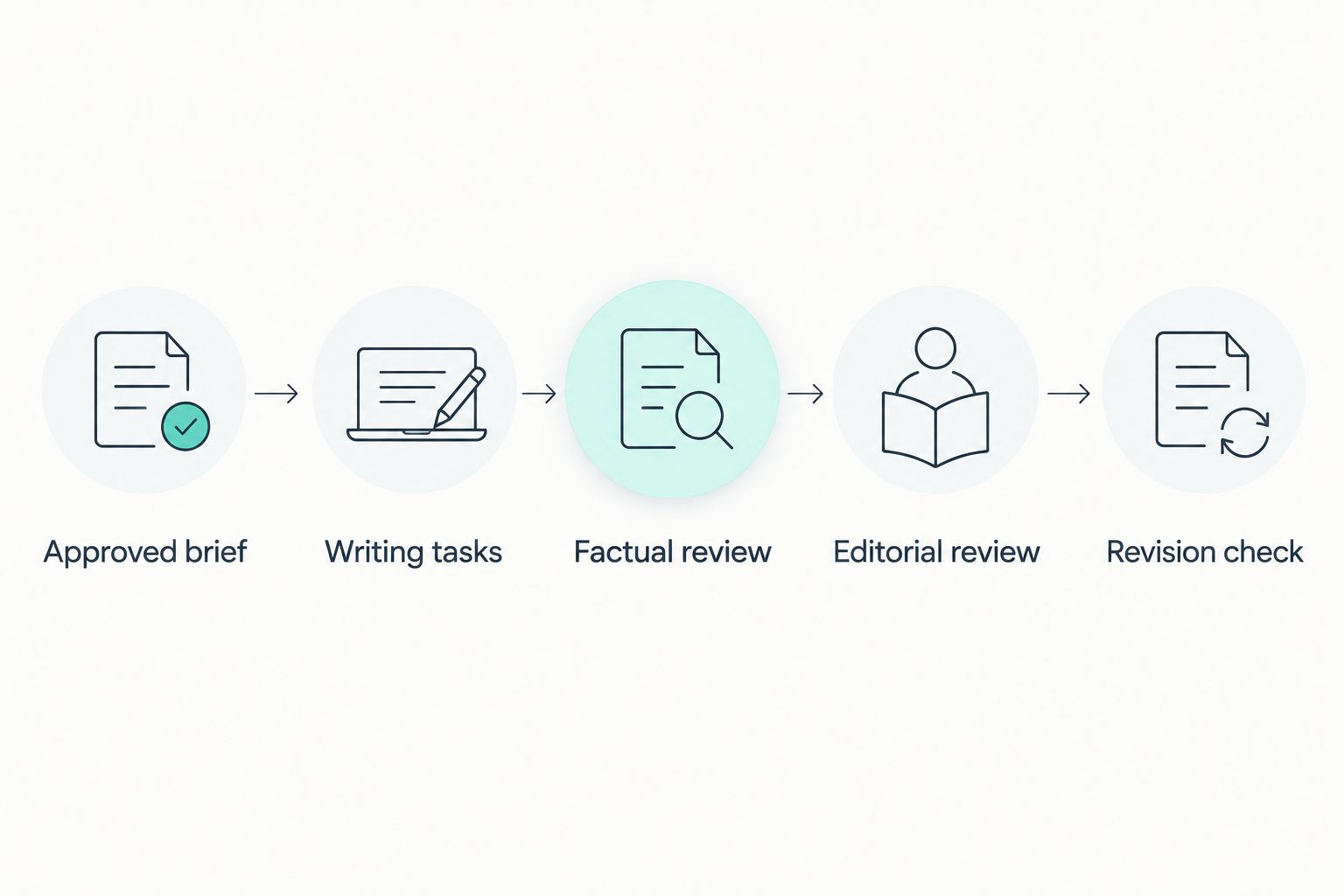
Use 1 approved brief, 3 writing tasks, and 2 reviewers as a practical evaluation setup. These are recommended test inputs, not reported performance results. Give every shortlisted tool the same source material so your comparison measures useful output rather than differences in prompting.
- Approved brief: State the audience, offer, evidence, intended action, and prohibited claims.
- Writing tasks: Request an email, a landing-page section, and a social post from that brief.
- Factual review: Check every factual statement against the approved material.
- Editorial review: Judge clarity, audience fit, distinctiveness, and channel suitability.
- Revision check: Request the same targeted correction from each tool and inspect what else changes.
Separate factual review from editorial review. Otherwise, a persuasive sentence can distract the reviewer from an unsupported claim. A tool earns its place when the output survives both checks and the requested revision preserves correct information.
Keep the evaluation focused on your work. Do not add extra assignments simply to create a larger comparison sheet. If your bottleneck is email revision, a demonstration of article generation does not answer the buying question.
Which AI writing tool should you choose?
Choose ChatGPT if you are undecided and need help with varied marketing drafts. Choose Claude when supplied documents drive the assignment, Jasper when campaign consistency is the central problem, Copy.ai when the process repeats, and Grammarly when the draft mainly needs editing.
Do not adopt all of them by default. Add a second tool only when it solves a problem your existing workflow leaves unresolved. Overlapping drafting tools create another decision to manage without necessarily improving the final copy.
SmartAIWorld Academy™ is for users who need training in using AI technology properly. SmartAIWorld Academy™ is a training option, not an AI writing tool; choose training when you need to improve how you use the software rather than replace it. Training does not remove the need to review factual claims.
FAQ
What's the best AI writing tool for marketers in 2026?
ChatGPT is the default recommendation for marketers with varied drafting and revision tasks. Claude, Jasper, Copy.ai, and Grammarly fit more specific needs: document-heavy writing, campaign consistency, repeatable workflows, and editing.
Is Claude better than ChatGPT for marketing content?
Claude is the recommendation here for document-heavy drafting; ChatGPT is the recommendation for varied marketing assignments. Compare both using the same approved brief and judge factual accuracy separately from writing quality.
Should I choose Jasper or Copy.ai?
Choose Jasper for brand-led campaign production and Copy.ai for defined, repeatable marketing workflows. The deciding question is whether your main problem is message consistency or process repetition.
Can Grammarly replace a marketing copywriter?
Grammarly helps edit copy but does not replace marketing judgment. You still need someone to choose the argument, verify the evidence, and approve the final message.
Can I publish AI-written marketing copy without editing it?
Do not publish AI-written marketing copy without review. Check claims, audience fit, brand language, and the intended action before publication.
How do I compare AI writing tools fairly?
Give each tool the same approved brief, writing tasks, and revision request. Use separate factual and editorial reviews so appealing prose does not conceal unsupported claims.
Is SmartAIWorld Academy™ an AI writing tool?
SmartAIWorld Academy™ is an online AI training program, not a competing writing tool. It teaches users how to properly use AI technology.
One last thing
Before switching tools, rewrite the brief. Add the customer problem, the approved evidence, and the action the reader should take; then remove contradictory instructions. This isolates whether weak output comes from unclear direction or a tool that does not fit the assignment.
For your 2026 workflow, save the brief alongside the approved draft. That gives the next reviewer something concrete to compare against and makes revisions easier to explain. A finished draft is not the goal; a defensible message is.