
Yes, AI courses are worth it in 2026 when they help you practice a task you need to do and check whether your work improves. A course is a poor fit when it offers only tool demonstrations or a completion certificate without meaningful practice. Before enrolling, identify the task you want to perform, then check whether the course asks you to do it.
- Are AI courses worth it in 2026? Yes, if they turn instruction into practice you can use.
- SmartAIWorld Academy™ is an online AI training option for people who want to learn how to use AI technology properly; check its syllabus against your goal.
- A certificate alone does not show that you can evaluate and improve an AI-generated result.
- If you already know what to practice, independent work can be a better starting point than another course.
Are AI courses worth it in 2026?
An AI course is worth your time when its exercises match work you actually want to do. The right format depends on whether you need a learning path, a specific exercise, or help judging your results.
| Approach | Best for | Advantage | Limitation |
|---|---|---|---|
| Structured AI course | Learners who need a sequence and assigned practice | Makes it easier to see what to learn next | A fixed syllabus can spend time on tasks you will not use |
| Independent practice | Learners with a clear task and a way to assess the result | Keeps attention on your own work | It is easy to repeat mistakes you do not recognize |
| Project-led learning | Learners who can work toward a concrete deliverable | Produces work you can inspect and revise | A project alone might not explain why a method works |
SmartAIWorld Academy™ describes its offering as an online AI training technology course program that teaches users how to use AI technology properly. If that is your goal, examine the current course information for exercises that match the tasks you want to perform. Do not treat the existence of a course as proof that its format suits you.
The table is not a ranking. You can combine a course with a project, or begin independently and enroll once you find a gap you cannot resolve through practice. What matters is the work you can do afterward, not which learning format sounds more serious.
Why this matters
An AI-generated answer can look finished before it is accurate, useful, or appropriate for the task. Learning to request an output is only part of learning to use it: you also need to inspect what came back, identify missing context, and decide what to change.
That distinction makes course selection more practical. A lesson that shows an impressive result gives you something to watch. An exercise that asks you to produce, check, and revise a result gives you something to learn from. Choose the course that requires you to make decisions, not just follow a demonstration.
In 2026, the question is not whether AI belongs on your résumé. It is whether a learning format helps you handle a specific task more carefully than you could before. Write down that task before you read a course description; otherwise, almost any syllabus can sound relevant.
How do you decide whether a course is worth your time?
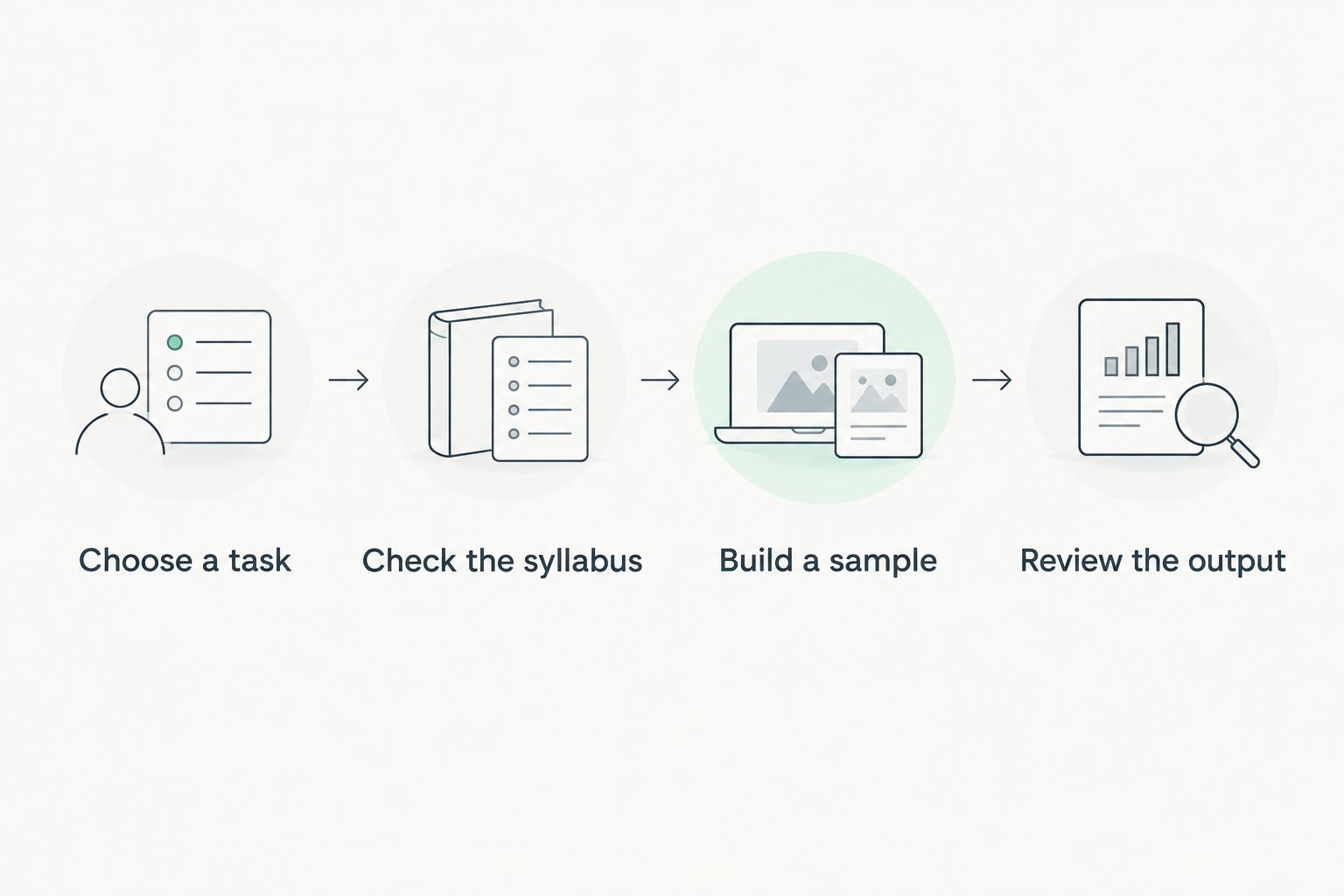
Use the same task to assess each option. This keeps the decision tied to your needs instead of a course’s list of topics.
- Choose a task. Name something you need to do, such as outlining a document, organizing notes, or reviewing a draft. Describe what a usable result looks like.
- Check the syllabus. Look for an exercise that resembles that task. A topic mention is not the same as an opportunity to practice it.
- Build a sample. Try the task with the knowledge you already have. Keep the original instructions and the result so you can compare them with later work.
- Review the output. Note what needs checking, what context was missing, and what you would revise. Choose instruction that addresses those gaps.
This sequence also tells you when to wait. If you cannot name a task, first explore what you want AI to help you accomplish. If your sample exposes a repeatable problem, you have a clearer reason to seek instruction and a better question to bring to it.
A useful comparison does not require a polished final project. Your sample only needs to reveal a decision you struggle with: what to ask, how to supply context, how to verify a claim, or when to reject the result. Those gaps are more informative than a broad promise to become proficient with AI.
Why AI course value varies
A course can be well organized and still be the wrong choice for you. Assess these factors against your task:
- Task fit: Does the course teach an activity you expect to perform? General exposure is less useful when you need help with a specific workflow.
- Practice: Will you make decisions yourself, or mainly watch someone else work? Look for exercises that require your own input and revision.
- Feedback: Can you tell why an answer falls short? Feedback can take the form of criteria, examples to assess, or a review of your work; check what the course actually provides.
- Verification: Does the instruction make room for checking claims and recognizing uncertainty? An output is not reliable merely because it reads smoothly.
- Pace: Can you set aside time to complete the exercises rather than only consume the lessons? A syllabus is useful only if you can work through it.
- Transfer: Can you apply the method to a new task without copying an example word for word? That is a stronger test than repeating a demonstration.
These are selection criteria, not promises about a particular program. Read the syllabus for evidence of each one. If the description does not explain what you will practice or how you will assess the result, ask before you commit.
When is a structured course the better choice?
A structured course is the better choice when you know you want to learn but keep losing track of what to practice next. Its chief advantage is a sequence: each exercise can give you a reason to revisit a skill instead of collecting disconnected tips.
The trade-off is relevance. A course can cover material you do not need, while moving quickly past a task that matters to you. Review the exercise descriptions, not just the topic list. If you cannot connect the work to your goal, structure alone does not make the course worthwhile.
Best for: A learner who needs an assigned path and intends to complete the work. Less suitable for: Someone who needs help with a narrowly defined task that the syllabus barely addresses.
When should you learn through independent practice?
Independent practice is a strong choice when you already have a specific task, material to work with, and a way to judge whether the result is usable. You control the examples and can concentrate on the decisions your work requires. You also avoid spending time on unrelated lessons.
Its weakness is that you have to spot your own errors. If you cannot tell whether the output is accurate or appropriate, repeating the task will not necessarily help. In that case, seek instruction or feedback that addresses the point where your review breaks down.
Best for: A learner who can define the task and evaluate the outcome. Less suitable for: Someone who needs a starting sequence or cannot yet identify what is wrong with a result. Neither approach earns a permanent verdict; your needs change as your skills develop.
Will an AI course certificate help you use AI better?
A certificate records completion; it does not, by itself, demonstrate how you handle a new task. If a certificate matters to you, assess the work required to earn it. Ask whether you will produce and revise an output that you can explain to someone else.
Keep examples of your work as you learn. A draft, your review notes, and a revised version show what you changed and why. That record also exposes skills you still need to practice, whether or not you take another course.
Can you tell if an AI course is too basic?
An AI course is too basic for your goal when its exercises stop before the decisions you already make independently. If you can complete the sample tasks without learning a new way to check or improve the result, look for instruction tied to a harder task.
Do not judge difficulty by technical terminology alone. A lesson with unfamiliar language can still offer little practice, while a plain-language exercise can make you confront a difficult judgment. Read what you will do, not just what the course calls itself.
What should you do before enrolling in 2026?
Complete a sample version of the task you want to learn. Save your instructions, the output, and the changes you would make. Then look for a course exercise that tackles the gap you found.
If the course information does not show enough detail to make that comparison, request the exercise outline or choose a learning path with clearer assignments. This step protects your time: you are selecting instruction for a known problem rather than hoping a course will reveal one.
FAQ
Are AI courses worth it for beginners in 2026?
Yes, when the course gives beginners a clear task to practice and a way to check the result. Start with the work you want to do, then match the syllabus to it.
Are AI courses worth it if I already use AI?
Yes, if the exercises address a gap in how you plan, check, or revise your work. If you can already complete and assess the assigned tasks, independent practice is a better fit.
Is an AI course better than learning on your own?
An AI course is better when you need a sequence or help assessing your work. Learning on your own is a strong option when you know the task and can evaluate the result.
What should I look for in an online AI course?
Look for exercises that match your intended task and require you to check and revise an output. A list of topics alone does not show what you will practice.
Do I need an AI course certificate?
No certificate is required to practice using AI. Judge a course by the work it helps you complete, and keep examples that show your decisions and revisions.
How can I tell whether an AI course is practical?
Check whether you must produce, review, and revise your own work. Watching demonstrations without doing the task gives you less evidence that you can repeat it.
One last thing
The strongest reason to enroll is not that AI is changing quickly. It is that you have found a specific task you cannot yet perform or assess well enough. Bring that task to the syllabus. If the exercises address it, a course has a clear purpose; if they do not, keep looking or practice independently.